The history of risograph printing
From office printer to art printer
There are few printing techniques with a history like that of the risograph printer. It was a machine that started as a practical tool for schools and offices. Decades later, however, the printer became a widely used technique for designers, illustrators, and artists worldwide. If you are looking for a risograph print, a risograph poster, or a risograph card today, you are actually buying something with a very interesting piece of history!

The invention of the risograph printer
In 1946, Noboru Hayama founded the Japanese company Riso Kagaku Corporation in Tokyo. In 1986, they introduced something entirely new to the market: the Risograph, a machine designed for low-cost, high-volume printing. Riso printing is actually a direct successor to the mimeograph, a stencil duplicator that existed as early as the late nineteenth century and worked by pressing ink through a stencil onto paper. For a very long time, that technique was the standard for anyone who needed more than a few but less than a thousand copies: for a school test or church bulletin, you went to the mimeograph; for thousands of copies, to a printing press.
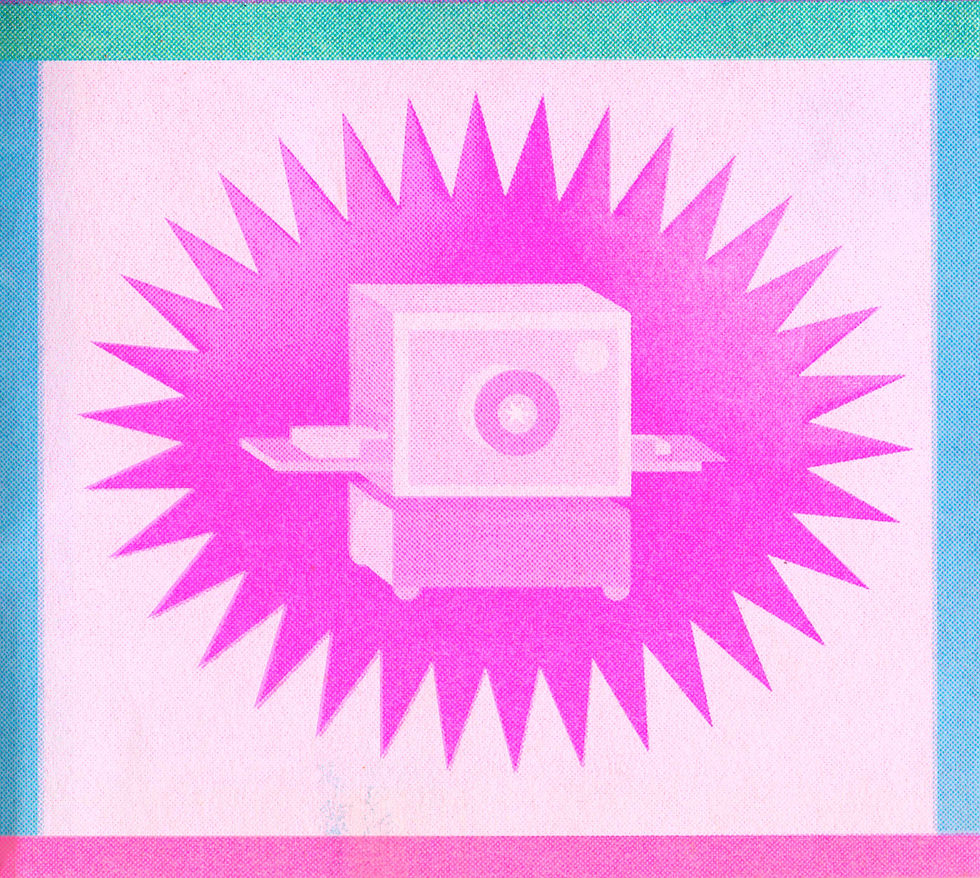
The risograph printer automated this, allowing you to print it yourself! It works like this: a thermally engraved 'master' (a small sheet of rice paper) is wrapped around an ink drum, and ink is pressed onto the paper through super tiny holes. A separate drum is needed for each color, and each color is printed separately.
The target group was initially schools, churches, and municipal offices. The machine was fast, pleasantly cheap to use, and required virtually no technical knowledge. Using the machine for art? No one had thought of that yet.
The underground
Sometime in the early nineties, another group of people began to discover the risograph printer: zine makers, punk bands, activists, and small publishers. There was a simple reason for this. For a fraction of the cost of offset printing (one of the few other print-by-print methods at the time), you could print dozens or hundreds of copies of your own magazine, flyer, or manifesto.
But there was also something else that appealed greatly to these groups. The ink dries differently from that of a conventional printer, with a soft, almost powdery surface. The colors are intense but limited: fluorescent pink, aqua blue, bright yellow, deep black. Added to this was a cool misregistration: when printing two colors, the layers never lie exactly on top of each other. Small shifts, overlaps, and edges that don't quite line up. With another technique, those characteristics would be considered bad or ugly. With the risograph printer, however, they were embraced, and it is precisely what appeals so much to people about this technique.
And now?
Around the early 2010s, something began to shift. Small, independent print studios started using the risograph printer for art! For designers and illustrators, the risograph printer was interesting for precisely the reasons the printer was not actually intended for.
The limited color palette means you cannot print all colors; the ink texture is a bit rough and difficult to replicate. The misregistration gives each printed copy a unique, very individual character, just a little different from the norm. Therefore, it is perfectly suited and fun for small-run prints, posters, and other artwork.
Riso printing today: workshops, prints and more
What makes risograph printing so special in today's world is that it is a very beautiful yet accessible technique. Anyone can learn it with a little guidance. And yet, it always produces results that are very unique and instantly recognizable by their texture, colors, and handmade appearance.
Riso cards, riso posters, and small runs of zines and booklets have a lovely, colorful quality that you simply cannot replicate digitally. In a world of digital perfection, and where we are heavily focused on things like AI, the riso printer offers something different: the presence of the creative process itself! :)
And perhaps that explains why an actually super simple Japanese office copier from 1986 is becoming increasingly popular. Right now, the riso printer is attracting young makers who are looking for something that a digital screen alone cannot give them. And that is super cool!